Why Your Soil Stops Absorbing Water — And What to Do About It
You water your plants. You fertilise on schedule. But the water sits on the surface, runs down the sides of the pot, and your plants still look dry and stressed. If this sounds familiar, the problem may not be what you’re putting into your soil — it may be that your soil has stopped absorbing it altogether.
Compacted and hydrophobic soil is one of the most common — and most overlooked — problems faced by Malaysian gardeners. Understanding what causes it, how to identify it, and how to fix it can make a significant difference to your plants’ health, your water usage, and your fertiliser costs.
What Is Compacted Soil?
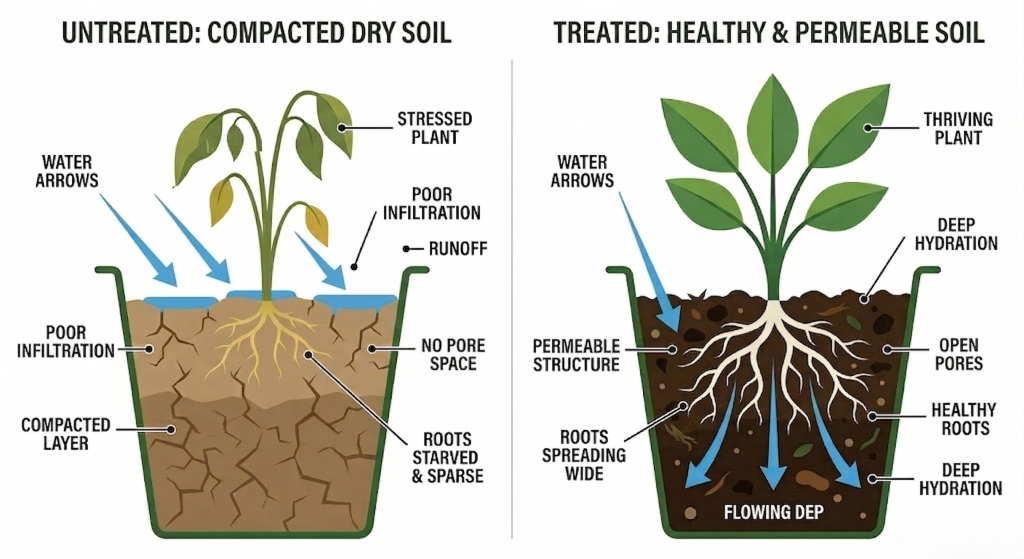
Healthy soil is full of tiny air pockets between its particles. These pockets allow water to move downward, carrying dissolved nutrients toward the root zone where plants can absorb them. When soil becomes compacted, those air pockets collapse. The soil becomes dense and hard, with little room for water or roots to penetrate.
Compaction happens gradually and is especially common in Malaysian gardens because of:
- Repeated watering — the pressure of water hitting soil over time compresses the surface layer
- Old potting mix — potting soil breaks down and settles over 12–18 months, becoming progressively denser
- Clay-heavy soil — clay particles pack together tightly, especially when alternately wet and dry
- Container gardening — soil in pots has nowhere to expand and compresses under its own weight
The result: roots struggle to grow, nutrients stay locked near the surface, and your plants show signs of stress despite your best efforts.
What Is Hydrophobic Soil?
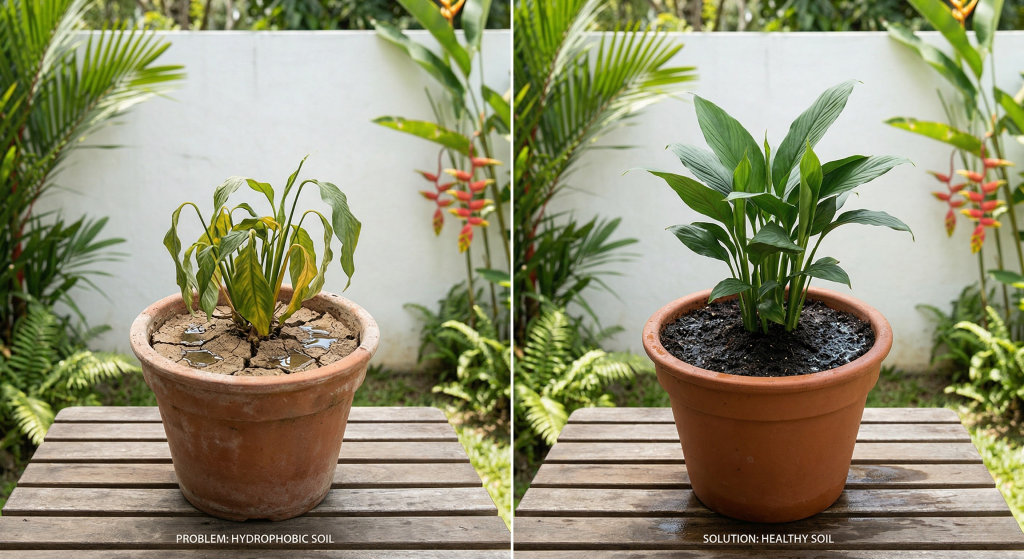
Hydrophobic soil takes the problem a step further. Rather than simply being dense, hydrophobic soil actively repels water. A waxy coating forms on individual soil particles — usually from the decomposition of organic matter — that causes water to bead up and roll off the surface rather than soak in.
This is particularly common in:
- Sandy soils that dry out quickly between waterings
- Old potting mix that has been in use for more than a year
- Pots that have been left dry for extended periods
- Garden beds in full sun where the soil surface bakes hard between rains
Hydrophobic soil is deceptive. You can pour water directly onto it and it appears to absorb — but look closely and you’ll see the water sliding down the inside edges of the pot, completely bypassing the root zone. The inner soil stays bone dry while the surface appears wet.
How to Tell If Your Soil Has a Problem
Before treating your soil, confirm what you’re dealing with. These three simple tests work for both pots and garden beds:
Test 1 — The Surface Observation Test
Water your plant slowly and watch what happens. Does water pool on the surface for more than 10 seconds? Does it run down the gap between the soil and the pot wall? Either indicates a problem with absorption.
Test 2 — The Finger Test
Push your finger 2–3cm into the soil. If the surface is hard or crusty and the layer below is bone dry despite recent watering, water is not penetrating into the root zone.
Test 3 — The Weight Test (For Pots)
Lift your pot immediately after watering. If it feels almost as light as before, most of the water drained straight through without being retained by the soil.
If any of these apply, you don’t necessarily need to replace your soil. You need to reactivate it.
Why This Matters More Than You Think
Beyond the obvious effect on plant health, compacted and hydrophobic soil quietly wastes resources — something that matters particularly now that input costs are rising.
Water waste: When moisture cannot penetrate, it evaporates from the surface or drains away before reaching roots. Gardeners with absorption-compromised soil often water significantly more frequently with diminishing returns.
Fertiliser waste: Nutrients dissolve in water. If the water isn’t reaching the root zone, your fertiliser isn’t either. You pay for every application — but your plants only receive a fraction of what you apply.
Time and effort: Plants in poor soil require more attention, more troubleshooting, and more intervention. Addressing the root cause early saves significant effort over a growing season.
The Fix: Serbajadi AquaBoost Soil Wetter
Rather than replacing your soil entirely, a soil wetter addresses the underlying problem directly — breaking down the barriers that prevent water absorption in the first place.
Serbajadi AquaBoost Soil Wetter is formulated specifically for Malaysian tropical conditions (24–35°C). It works by reducing the surface tension of water — allowing it to penetrate compacted and hydrophobic soil instead of running off. Once the barrier is broken, water and the nutrients dissolved in it can travel deep into the root zone where your plants actually need them.
What AquaBoost Does for Your Garden
- Breaks the hydrophobic barrier — eliminates the waxy coating that causes water to repel
- Improves water penetration — moisture reaches deep into the root zone, not just the surface
- Maximises fertiliser effectiveness — nutrients travel with water to where roots can absorb them
- Retains moisture longer — soil holds water between waterings, reducing how often you need to water
- Works on all problem soil types — clay, compacted earth, old potting mix, sandy soils, and dry lawn patches
- Safe for edibles and ornamentals — suitable for vegetables, herbs, fruit trees, flowering plants, and lawns
How to Use AquaBoost
AquaBoost fits into your existing watering routine without any additional equipment or effort.
Dilution: Mix 10ml of AquaBoost with 1 litre of water. Stir well before applying.
Application: Apply the diluted solution evenly over the soil surface using a watering can or garden sprayer until the soil is well moistened.
Frequency: Use every 2–4 weeks, or as needed based on your soil’s condition and how quickly it dries out.
For severely dry or compacted pots: Apply the solution and allow it to sit for 30 minutes before following up with a regular watering. This gives the wetting agent time to break down the hydrophobic layer before more moisture is introduced.
Best time to apply: Early morning or late afternoon — cooler temperatures reduce evaporation and allow the solution to work more effectively.
For severely hydrophobic soil, apply twice in the first week, then move to the regular 2–4 week schedule.
Frequently Asked Questions
What causes soil to stop absorbing water in Malaysia?
Soil stops absorbing water due to two main causes: compaction and hydrophobicity. Compaction occurs when repeated watering, old potting mix settling, or clay-heavy soil causes air pockets to collapse, making soil dense and impenetrable. Hydrophobic soil develops when a waxy coating forms on soil particles from decomposing organic matter, actively repelling water. Both conditions are very common in Malaysian gardens due to our tropical heat and high humidity.
How do I know if my soil is compacted or hydrophobic?
There are three simple tests. First, water your plant slowly — if water pools on the surface for more than 10 seconds or runs down the pot edges instead of soaking in, absorption is compromised. Second, push your finger 2–3cm into the soil — if it is hard and dry underneath despite recent watering, water is not penetrating. Third, lift your pot immediately after watering — if it feels almost as light as before, very little water was retained by the soil.
Can I fix compacted or hydrophobic soil without replacing it?
Yes. In most cases, you do not need to replace your soil. Serbajadi AquaBoost Soil Wetter is specifically formulated to break the surface tension that causes water repellency and compaction-related runoff. Applied at 10ml per litre of water every 2–4 weeks, it allows water and dissolved nutrients to penetrate deep into the root zone. Most gardeners notice improved absorption from the very first application.
Is AquaBoost Soil Wetter safe for edible plants and vegetables?
Yes, AquaBoost is safe for edibles and ornamentals alike. As a precaution, Serbajadi recommends a 7-day withholding period before harvesting edibles that have been treated, and thorough washing of produce before consumption.
Will AquaBoost help my fertiliser work better?
Yes — this is one of AquaBoost’s most practical benefits. Nutrients dissolve in water. If water cannot penetrate your soil, your fertiliser cannot reach the root zone either. By improving water absorption, AquaBoost ensures that the fertiliser you apply actually travels to where your plant roots can use it, making every fertiliser application more effective.
Give Your Soil What It Needs to Receive What You Give
Healthy plants start with soil that can absorb and hold water properly. If your soil has become compacted or hydrophobic, no amount of watering or fertilising will fully compensate — because the nutrients and moisture never reach the roots.
Fixing your soil’s ability to absorb water is one of the most practical and cost-effective changes you can make as a gardener. It requires no new equipment, no soil replacement, and no change to your existing routine.
Ready to fix your soil? Get Serbajadi AquaBoost Soil Wetter and start seeing the difference from your very first application.